Art history
What you’ll find inside Hokusai’s Manga sketchbooks
Long before the word came to describe modern comic series abroad, Hokusai used it for a collection full of gestures, animals, landscapes, and everyday lives.
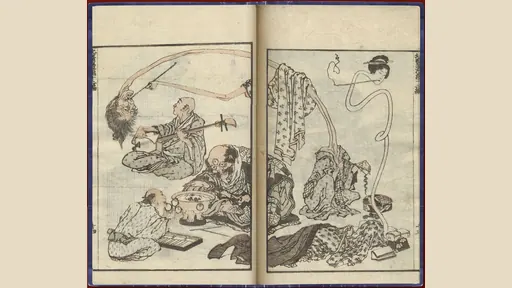
A book you can open almost anywhere
The first volume of Hokusai Manga appeared in 1814. The Metropolitan Museum of Art traces its material to sketches Hokusai made while staying with a pupil in Nagoya, then prepared as woodblock prints. The series grew over later volumes. Across the books, you encounter people at work, animals, plants, and landscapes. Some images offer a whole scene. Others are a place to study a single pose or shape.
These are illustrated books of studies, with a different purpose and structure from a contemporary serialized manga. The title is a useful way into that difference. You can turn to a spread to see what an artist noticed and collected without needing to know what happened in the preceding chapter.
Look at how an action is held still
Take one figure and imagine putting it into a comic panel. What is it doing and what has to stay visible for the pose to read? A bent knee, a hand reaching away from the body, or a head turned against the line of the shoulders can make the whole action recognizable. When many studies share a page, it’s easy to compare how small changes in direction and weight produce different kinds of movement.
For an artist, the useful exercise is to describe the pose in a few words before redrawing it. “Someone carrying a heavy object” gives you a reason to look at the hips and shoulders. Try a second version with fewer lines. Keeping the weight readable will teach you more about the original than copying its outline mechanically.
Follow a page into the rest of the collection
The public-domain reproduction used here is one spread. The broader archive has scans of whole volumes, which make it possible to see how studies are grouped and how the character of the drawings shifts when a new subject takes over. Pick a volume and choose three pages to compare. Each will give a different answer to what a sketchbook can make worth looking at.